Kilowatt Ours is a timely, solutions-oriented look at one of America’s most pressing environmental challenges.

Award-winning film Kilowatt Ours: A Plan to Re-Energize America is a
timely, solutions-oriented look at one of America’s most pressing
environmental challenges: energy.
Filmmaker Jeff Barrie offers hope as he turns the camera on himself and
asks, “How can I make a difference?” In his journey Barrie explores
the source of our electricity and the problems caused by energy production
including mountain top removal, childhood asthma and global warming. Along
the way he encounters individuals, businesses, organizations, and communities
who are leading the way, using energy conservation, efficiency and renewable,
green power all while saving money and the environment.
We can solve the climate crisis
|
Climate change is real. And it's happening much faster than was predicted just a few years ago. The good news is that we can solve this crisis. We can switch 100% of America's electricity to clean energy sources - within 10 years. To make the switch, empowering America must be a priority for our leaders. If leaders know you care, they will take action. Join us today and be a voice for solutions. http://www.wecansolveit.org/ |

You are what you eat!
|
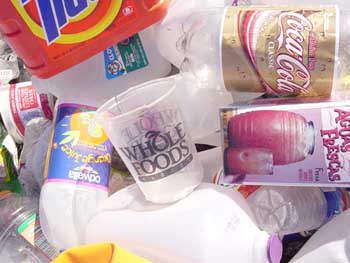
When you eat or drink things that are stored in plastic, taste it, smell it, wear it, sit on it, and so on, plastic is incorporated into you. In fact, the plastic gets into the food and food gets into the plastic and you. So, quite literally, you are what you eat[1]. . . drink. . . and breathe plastic! These plastics are called "Food Contact Substances" by the US Food and Drug Administration (FDA), but until April 2002, they were called "Indirect Food Additives."[2] The new name is cleansed of the implication that plastic gets into your food. In spite of this semantic deception, migration is a key assumption of the FDA.
|
 http://www.mindfully.org/Plastic/Plasticizers/Out-Of-Diet-PG5nov03.htm |
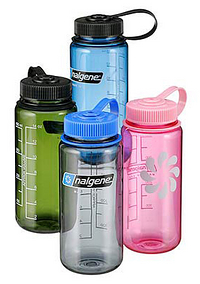
Wal-Mart, Nalgene Move Away From Bisphenol A
|
Popular plastic water bottles, sippy cups and baby bottles made
with a chemical called bisphenol A may be on their way out. |
 http://blogs.wsj.com/health/2008/04/18/wal-mart-nalgene-move-away-from-bisphenol-a/?mod=WSJBlog |
Say No! - to Plastic Bags By V.KRISHNA MOORTH WHAT ARE PLASTICS?
|
Plastics are synthetic substances produced by chemical reactions. Almost all plastics are made from petroleum, except a few experimental resins derived from corn and other organic substances. |
 http://www.vigyanprasar.gov.in/comcom/plasticbags.htm |
Trashing the Oceans
|
One brilliant summer morning in 2000, the small private research
vessel Alguita discovered a 10-mile-wide flotilla of the disposable
sacks, an estimated 6 million of them destined for Taco Bells around
the country, bobbing more than 1,000 miles west of the Ventura store.
We were out in the middle of the Pacific, where you would think
the ocean would be pristine, recalls the Alguitas captain, Charles
Moore. And instead, we get the Exxon Valdez of plastic-bag spills. |
|
|
A. 1990 Running shoes spill |
|

Trashed - Across the Pacific Ocean, Plastics, Plastics, Everywhere
|
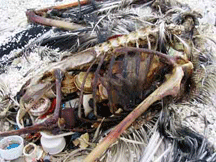
Bottle caps and other plastic objects are visible inside the decomposed
carcass of this Laysan albatross on Kure Atoll, which lies in a
remote and virtually uninhabited region of the North Pacific. The
bird probably mistook the plastics for food and ingested them while
foraging for prey. |
 http://www.mindfully.org/Plastic/Ocean/Moore-Trashed-PacificNov03.htm |
Recycling FACTS
|
|
|

Recycling just one aluminum coke bottle saves enough energy to run a
television for 3 hours.
Recycling just 3 feet of newspaper you save a rain forest tree.
Recycling reduces the amount of waste to incinerate or landfill.
Recycling reduces air and water pollution.
Recycling conserves precious natural resources - since less raw materials
need to be extracted and processed.
Recycling saves energy - in 1996 the energy savings from recycling in
the
Recycling makes us more sustainable because we are borrowing less materials
and energy from our children's future.
Recycling Challenge
When we started recycling, we had so many items that we had to call the
town to request a third recycling bin. We fill 3 bins a week and usually
need to use some brown paper bags as extra collection bins. We have made
recycling a family challenge.
Here are some simple changes my family made after watching the documentary
"Hawaii message in the waves by BBC." This documentary was a
very informative and entertaining look at the serious and harmful results
of plastic trash on Hawaii's beaches and sea animals.
1. We no longer pack sandwiches in plastic baggies.
2. We use containers that can be washed and reused to pack our school
lunches.
3. We never use plastic bags for groceries. We bring our own bags and/or
we request paper-bags. We use the paper-bags to hold recyclables curbside.
4. We check all items we buy, and if they are recyclables, we recycle
them curbside. If they are not recyclable we try to find a company that
makes that product in a recyclable package for next time.
5. We buy local products, such as fruits, and veggies that are not packaged
at all, and we do not use the plastic bag to hold them while we shop.
We put all our veggies and fruits in the top bin of the shopping cart.
This saves us throwing the small plastic bags away when we unpack the
groceries at home.
6. Read labels at the store and buy items that are recyclable. Items
that support our growth and survival.
Keep track of how much you recycle at home using your curbside recycling
or a drop off program. Take photos and e-mail them to us. You can also
snail mail them to 398 Palisado Ave, Windsor, CT 06095 C/o Green Eco Warriors.
You may see your photos on our website in the near future!
Recyclable Materials for Windsor Connecticut Curbside Collection
Mixed Paper
| ACCEPTABLE ITEMS | UNACCEPTABLE ITEMS |
| Newspapers | Plastic bags |
| Cardboard (please flatten boxes and tie larger bundles) | Wax paper |
| Brown bags | Tissue paper |
| Magazines | Trash items |
| All grades of office paper | Food debris |
| Phone directories | |
| Junk mail | |
| File folders | |
| Chip Board products | |
| Catalogs | |
| Color inserts | |
| School paper | |
| Books(hardcover / soft cover) | |
| Envelopes(with or without cellophane windows) |
Bottles, Cans, Plastics
| ACCEPTABLE ITEMS | UNACCEPTABLE ITEMS |
| Clear, brown or green bottles | Ceramic items - cups, plates, dishes |
| Tin cans | Pyrex ware |
| Aluminum cans | Plastic bottles - #3 through #7 |
| Aluminum foil - rinsed only, please | Plastic toys, plastic bags |
| Plastic bottles - #1 & #2 only | Trash items |
| Aseptic containers(milk or juice) | Un-rinsed containers |
| Please rinse all items | |
| Lids and caps are OK |
Pots and Pans
| ACCEPTABLE ITEMS |
| Metal Pots Metal Pans |
Next steps
Now that you are armed with some new knowledge, you may feel compelled
to learn more. Make recycling and saving our planet a family goal. It
won't be long before you start to see positive changes.
"We are not tree huggers. We are air breathers. We are Green Eco Warriors."
We are compelled to show our strengths and defend what is ours. We have
the right and a duty to defend our environment and our planet. We have
a calling to learn and teach a gentle and sustainable way of life for
the generations that will follow us. We are the Green Eco Warriors.
If you are anything like us, you probably like or even love animals.
You will probably want to preserve our planet's natural beauty. You want
our rainforests, glaciers, and coral reefs to thrive.
Let's take back our fields, our parks our rivers, and oceans. Lets become
ECO-WARRIORS!
Los Angeles River, photo taken after a recent storm
LA Public Works removing debris caught by booms from the LA River after a storm event.
Kamilo Beach on February 8, 2006
1 square meter of trash on Kamilo Beach on February 8, 2006
One mile trawl sample of North Pacific Gyre
Kure-Atoll Albatross and the trashed beach